
Whispers of Love
In Mischna, evening came early.
By late afternoon, the street outside Alexander’s bookshop had already grown quiet. A woman with a basket passed once. A cart went by with one loose wheel making a soft sound against the stones. After that, there were only footsteps, now and then, going elsewhere.
Alexander turned the sign on the door.
Closed.
He always used the same hand.
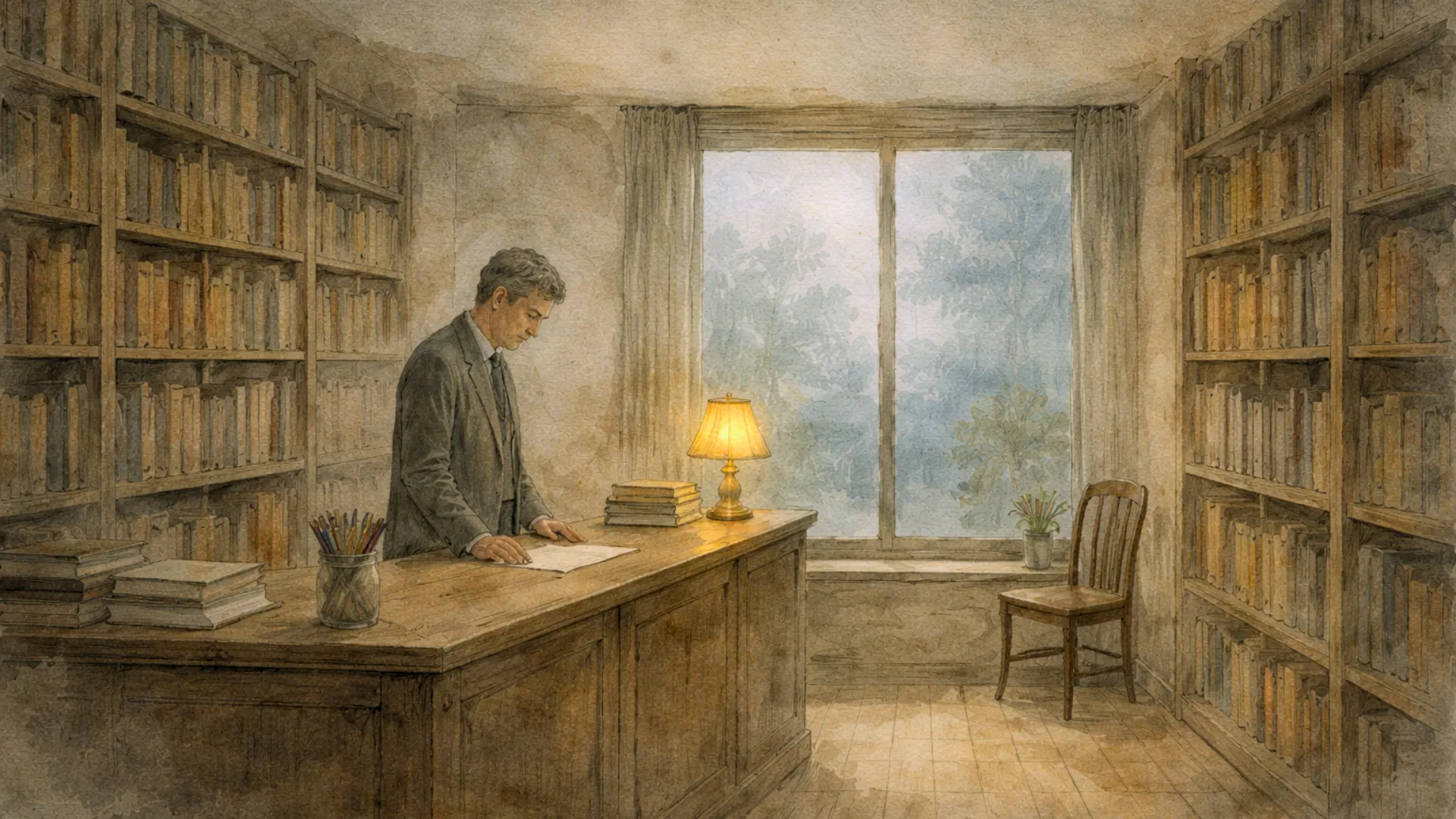
Inside, the shop looked as it usually did. The shelves bent a little under old hardbacks. A lamp near the counter gave a low yellow light. It was too soft for searching the higher shelves, but enough for staying in the room. By the back window stood a chair no customer ever chose. Alexander sometimes sat there in the last part of the day with a book open on his knee.
He lived above the shop.
At night, the boards upstairs spoke in the same places. The kettle took longer than it should. One window needed to be pressed twice before it shut properly. In winter, the corner near the bed held the cold a little longer than the rest of the room.
These things had not changed in years.
One rainy afternoon, while moving books from the back room to the front, Alexander found a folded letter inside a novel with a loose cover.
He slid it out with two fingers and looked at it for a moment.
Then he opened it.
The paper had gone soft at the folds. The writing was narrow and even.
I went to the meadow again today.
The grass had bent in the same direction as yesterday.
I thought that if I stood still long enough, I might hear your steps before I saw you.
That was all he read then.
The bell over the door rang. A customer came in asking for almanacs and left with nothing. Alexander put the letter beside the till and went back to the books.
Near closing time, he read the rest.
It was not long. There was no date. No surname. Only a name at the bottom.
Isabella.
He folded the paper, not quite along the same lines, and left it beside the jar of pencils while he counted the coins in the till.
That evening he carried it upstairs in the pocket of his coat.
Over the next few days, he looked through the novel again, then through the other books that had arrived from the same estate. Most held nothing. In one he found a receipt. In another, a pressed leaf flattened almost to dust. In a book of poems, near the back, there was a second note in the same hand.
It mentioned a path over a hill, a change in the weather, and a pair of gloves left on a bench one afternoon and never collected.
At the bottom, again, was the same name.
Isabella.
Alexander kept the two letters in the drawer beneath the wrapping paper.
Sometimes in the middle of the day he opened the drawer and looked at them without taking them out. Sometimes he stood with the dusting cloth in one hand and the other resting on the counter.
After a week, he asked the baker whether he had ever known anyone called Isabella.
The baker shook his head and asked whether she owed money.
Alexander said no.
A few days later he took the letters to Julian, who kept the antique shop near the square.
Julian put on his spectacles and read one letter, then the other. He held them lightly, as he held old invoices and photographs and other paper things people brought him.
“These are older than they first look,” he said.
Alexander waited.
Julian turned one page a little toward the window.
“There was an Isabella Marr,” he said. “A long time ago. She wrote short pieces for the local paper. Poems, mostly.”
He gave the letter back.
“She was to marry a man called Vincent. He died before that happened.”
Alexander folded the letters and put them in his pocket again.
Julian stood with one hand on the glass counter.
“People used to say she walked out to Lover’s Meadow after that,” he said. “Though people say all sorts of things once enough time has passed.”
“Lover’s Meadow,” Alexander said.
Julian shrugged. “Places keep their names.”
The meadow was not far outside town.
Alexander went there two evenings later, after he had closed the shop and put the unsold postcards back in their box. The path was narrower than he had expected. Grass grew over part of it. At one turn he thought he had gone the wrong way. Then the trees opened and he saw the field.
It was a plain stretch of uneven grass with one old tree near the middle.
There was no sign.
No bench.
No path worn neatly through it.
Only the field and the tree and the hedge beyond.
Alexander stood with his hands in his coat pockets.
A breeze moved through the branches. Somewhere farther off, a bird made one short sound.
He might have left then. Instead he walked to the tree and looked down near its roots. Under leaves and damp earth he found a small tin pushed halfway into the ground.
It came loose easily.
Inside was another letter.
This one was shorter.
I was here again, though I said I would not come.
The tree keeps its own counsel.
I thought time might make things lighter, but it has only made them quieter.
There was one mention of Vincent by name. The rest was about the weather and the light on the grass.
Alexander read the note twice. Then he put it back into the tin and carried both home.
That night he woke once and lay still in bed, listening. Rain touched the window. The boards downstairs gave one small sound and then none.
In the morning he opened the shop at the usual time.
A child came in before noon and spent five minutes choosing between two marbles from the dish by the till. An older woman bought a cookbook with a stain on the first page and said she preferred books that had already been used by someone. In the afternoon the lamp had to be lit earlier than usual.
The letters remained in the drawer.
He asked two more people about Isabella. One said she thought she remembered a winter coat with fur at the collar. Another thought she had left town. Neither spoke as though sure.
After that, Alexander stopped asking.
One afternoon, near closing, a woman he had not seen before came into the shop.
She wore a dark green coat darkened at the shoulders by rain. She stood inside the door for a second before moving farther in, as if waiting for her eyes to settle in the lower light.
“Are you still open?” she asked.
“Yes,” Alexander said.
She nodded and went to the shelves on the left. At first she did not touch anything. Then she ran the flat of her fingers over the spines until she came to a thin book of essays and pulled it out.
She carried it to the counter.
“You have a quiet shop,” she said.
Alexander looked at the book in her hands. “Yes.”
When she paid, her card case opened the wrong way round for a moment, and he saw her name.
Olivia.
The next week she came back.
This time she asked whether he had any poetry.
“Not love poems,” she said. “Or not too many of them.”
Alexander showed her three books. She read the first lines of each and bought none.
Before she left, she put one of them back in the wrong place. After the door closed, Alexander moved it to its shelf.
Olivia returned again a few days later, and after that from time to time without a pattern he could be certain of. Sometimes there were four days between visits. Sometimes ten.
Their conversations stayed small.
A torn spine.
A poor translation.
The church bell in fog.
The smell of paper in damp weather.
Once she stood at the counter while rain ran down the window in long uneven lines. She held one glove in her hand and did not put it on.
Alexander opened the drawer beneath the wrapping paper and took out one of Isabella’s letters.
He laid it on the counter.
Olivia read it slowly, with one finger resting near the bottom of the page but not touching the name. When she finished, she folded it and slid it back toward him.
“Did you find the place?” she asked.
Alexander nodded.
“There was a field,” he said. “And a tree.”
Olivia looked toward the window. “That sounds like enough.”
Alexander put the letter back in the drawer.
After that, he showed her the second letter too. He did not say much around them. She did not ask for much more.
One Sunday, when the shop was closed, they walked out together to Lover’s Meadow.
The weather had not fully settled into spring. The ground still kept some damp under the grass. Olivia stopped once to pull a twig from her sleeve and held it for a second before dropping it.
When they reached the tree, Alexander took the tin from his coat pocket and gave it to her.
She opened it and read both letters again.
Then she closed the lid and handed the tin back.
For a while neither of them spoke.
The field was quiet. Beyond the hedge someone was chopping wood. The sound came slowly, with a pause between each strike.
At last Olivia said, “She kept coming here.”
Alexander looked at the grass near his shoes.
“Yes,” he said.
They walked back before the light had gone.
Near town, Olivia said, “You could leave them there again.”
Alexander looked at her.
“The letters,” she said. “Or keep them. Either seems all right.”
He nodded once.
The next time she came into the shop, Alexander stepped away from the counter too soon, as if making room for someone carrying something large, though Olivia had only a book in one hand and her gloves in the other.
On another day, while she was looking at a book of sketches, he began wrapping it before she had said she wanted it.
“I’m not taking that one,” she said.
Alexander set the paper flat again. “Sorry.”
Olivia touched the edge of the open book and then let her hand fall.
After that, she did not come for a while.
Nothing much changed in the shop.
A new box of calendars arrived and sat unopened until Thursday. A schoolboy came in three afternoons in a row to look at the same atlas. Dust gathered on the top shelf above Travel. The lamp near the counter had to have its bulb tightened one evening when it began to blink.
Alexander opened and closed the shop. He boiled the kettle upstairs. He pressed the window shut once, then again.
In the late afternoon, when the street grew quieter, he sometimes looked up before the bell over the door had rung.
One evening, after closing, he took one of Isabella’s letters upstairs and read it by the window.
The light was poor. He had to stand close to the glass.
When he had finished, he folded the page and left it on the table beside the lamp.
In the morning he opened the shop a little earlier than usual.
Olivia came in just before noon.
Her coat was damp from rain. She carried a book under one arm.
“I should probably return this,” she said. “Though I haven’t finished it.”
Alexander took the book and looked at the due date card inside.
“You can keep it longer,” he said.
Olivia nodded.
Rain tapped at the window. Somewhere at the back of the shop a board gave a small dry sound.
Alexander set the book on the counter between them.
“I was awkward,” he said.
“Yes,” said Olivia.
He nodded.
For a moment they both looked at the book.
Then Olivia said, “Are you still walking on Sundays?”
“Sometimes.”
She rested her hand on the counter. “Would you like to this week?”
Alexander looked at her hand, then at the rain on the window.
“Yes,” he said.
That Sunday was cool and clear.
They took the longer path by the stone wall. At one wet patch Olivia touched his sleeve lightly to steady herself, then let go. Neither of them spoke of it.
When they reached the meadow, they did not read the letters.
Alexander had brought the tin but left it in his pocket.
They stood under the tree and looked out over the field. The grass moved in one direction with the wind, then in another when it shifted. High in the branches something clicked softly against the bark.
Olivia tipped her head back a little and looked up.
“Do you think she would mind,” she said, “other people coming here?”
Alexander took his time answering.
“No,” he said.
Olivia looked at him then.
Alexander looked back.
After a moment he held out his hand.
Olivia put hers in it.
That was all.
They stayed where they were for a little while longer, then turned back toward town.
By the time they reached the shop, the light had started to lower. Olivia stood just inside the door while Alexander unlatched it and then again while he closed it behind her.
She did not stay long. She looked at two books and bought neither. Before leaving, she touched the counter once with the tips of her fingers, as people do when steadying themselves to put on a glove.
Then she went.
Alexander did not light the lamp at once.
He stood behind the counter in the dim shop. The books were where they had been. The chair by the back window still faced slightly the wrong way. From upstairs he could already imagine the sound the kettle would make before boiling.
Near the till, one pencil had rolled away from the others.
He picked it up and set it back in the jar.
Then he turned the sign on the door and listened to the small tap it made against the glass.
For a while he remained where he was.