
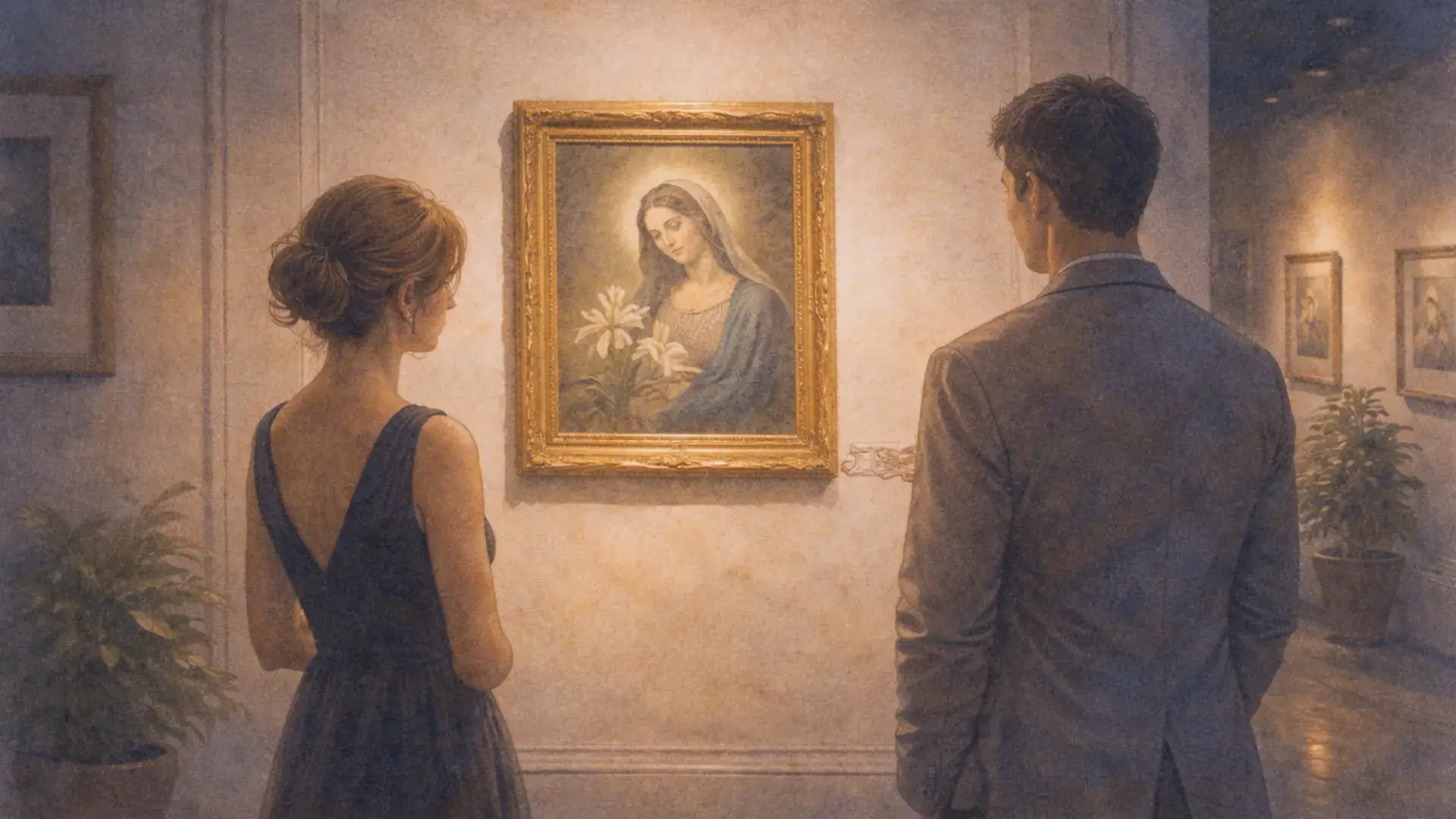
A Stranger in the Gallery
The gallery stayed open later than usual that night.
Not for a crowd exactly. Just longer.
Outside, the streetlights leaned toward the pavement as if tired.
The river was somewhere nearby, but from inside the building it could only be guessed at, a cool presence pressing faintly against the glass.
Penelope arrived before the last technicians finished adjusting the lights. She walked the rooms without hurry, stopping where she always stopped, not in front of the most valuable pieces, but near the corners—where reflections gathered, where the walls seemed to listen.
The painting had already been hung.
A small work, quieter than expected. Cream-colored lilies, slightly bruised at the edges. The Madonna’s face turned not quite toward the viewer, not quite away.
Nothing dramatic.
It resisted attention.
Penelope stood in front of it longer than she had planned. The label beneath it still smelled faintly of ink.
She adjusted nothing.
When the doors opened, the guests entered carefully, as if the floor might object. Shoes softened themselves against the marble. Voices stayed low, even before anyone asked them to.
Penelope greeted people with her usual nods. She touched shoulders lightly. She remembered names, not because it mattered, but because it was easier than explaining why she didn’t.
The evening dress she wore was darker than the room. It caught light only when she turned, which she did less often than usual.
At some point—she could not later say when—she noticed the man.
He wasn’t near the painting at first. He stayed back, near a case of drawings no one paid attention to anymore. His suit was ordinary. No tie. His shoes looked recently cleaned, which struck her more than if they had been worn.
He wasn’t watching the people.
He was watching the room.
Penelope told herself this meant nothing. Rooms were meant to be watched. That was their function.
When it was time to speak, she stepped forward. Her voice carried easily, as it always did, though she had not raised it.
She said the title of the painting. She said where it had been found. She avoided adjectives. She had learned long ago that adjectives made people restless.
The cloth slid away. Applause followed, uneven, polite.
The man did not clap.
He moved closer then, not directly, but in a slow curve, as if pulled by something indirect. He stopped a few steps from the painting. His hands stayed loose at his sides.
Penelope noticed how still he became.
Later—much later—she would think that this was the first moment she should have left the room.
Instead, she crossed it.
“You’ve been quiet,” she said, standing beside him, not facing him.
“Yes,” he replied. After a pause: “It seemed appropriate.”
They stood like that for a moment. The lilies absorbed the light without reflecting it back.
“You don’t like it,” she said.
“I didn’t say that.”
“No,” she agreed.
He leaned slightly forward, as if listening to something inside the frame. “It feels unfinished,” he said. “Not the painting. The way it’s here.”
Penelope watched his reflection in the glass. His face was older than she’d first thought. Not by much. Enough to matter.
“And what way would that be?” she asked.
He smiled, but only briefly. “Protected,” he said. “Very carefully.”
She turned then. “We do our best.”
“I’m sure you do.”
People passed behind them. Someone laughed too loudly and stopped when they heard themselves.
“Do you work with art?” Penelope asked.
“Sometimes.”
“That usually means no.”
“That usually means something else,” he said.
She waited. He didn’t offer more.
“My name is Penelope,” she said, finally.
“I know.”
She looked at him. He met her gaze without effort.
“And yours?”
He hesitated. It was small, but she felt it. “Rowan,” he said.
They did not shake hands.
The evening thinned. Glasses emptied. Coats were collected. Compliments were exchanged and forgotten before they finished being spoken.
Rowan remained.
When the last guest left, Penelope stayed near the main hall. The guards moved into their night patterns. Doors sealed softly.
Rowan was no longer visible.
She told herself he had left.
She did not fully believe it.
In the surveillance room, the screens glowed with their usual indifference. Hallways repeated themselves. Frames hung, unmoving.
Then something shifted.
Not abruptly. Just enough.
Penelope leaned closer. The figure moved with a patience that suggested familiarity. He paused when the light changed. He waited when it didn’t.
She did not call out. She did not sit down.
By the time she reached the gallery, he was already there.
Rowan stood in front of the Madonna, closer than before. The room felt smaller, as if it had folded slightly inward.
“You should leave,” she said.
“I will,” he answered. “Soon.”
“You won’t take it.”
“I won’t tonight.”
She considered this. “You came prepared.”
“Yes.”
“And you’re leaving empty-handed.”
“For now.”
They stood with the painting between them.
“You know,” she said, “this isn’t the kind of work that disappears easily.”
“No,” he agreed. “That’s why it matters.”
She moved a step closer. “If you wanted it, you should have taken it years ago. Before it was found.”
He looked at her then. Really looked. “Before it was named,” he said. “Before it learned how to behave.”
Silence settled again. The guards were minutes away. She hadn’t pressed the alarm. She wasn’t sure why.
Rowan stepped back.
“You’re good at this,” he said.
“At what?”
“Standing still when you shouldn’t.”
She watched him retreat, not toward the exit, but toward the shadow between rooms. When he vanished, it felt less like escape than erasure.
The alarm remained untouched.
Weeks passed. The painting drew visitors who stood too close and then apologized to no one. Articles appeared. Names were repeated.
Nothing else happened.
Until the package arrived.
It was small. Unremarkable. No return address.
Inside was a replica. Careful. Almost exact, except for a faint difference in the lilies—something softened, or perhaps removed.
The note contained only one line, written without flourish.
For the one who knows when not to move.
Penelope placed the replica in her study, not on the wall, but on a shelf, partly hidden by books she rarely opened.
Sometimes, late in the evening, she noticed herself glancing toward it without meaning to.
The original remained in the gallery, unchanged.
The room learned how to hold it.
And occasionally—very occasionally—Penelope felt that the space between the frames had shifted again, just slightly, as if remembering a figure that had once stood there and chosen, at the last moment, to leave.
Aveline Moorwen